
Full, View #1

Full, View #2

Full, View #3

Detail #1

Detail #2
Zen Garden
Watercolor Paper, Copy Paper, Wood Glue
10" x 9.5"

The most famous of these, perhaps, is the garden at Ryōanji, which calls to mind a vast ocean dotted by small islands, or Daisen-in, which features a stone waterfall “pouring” into a vigorously flowing mountain river. The use of rocks as the dominant feature of the garden has both historical and aesthetic origins.
https://www.asianstudies.org/publications/eaa/archives/cultivating-enlightenment-the-manifold-meaning-of-japanese-zen-gardens/
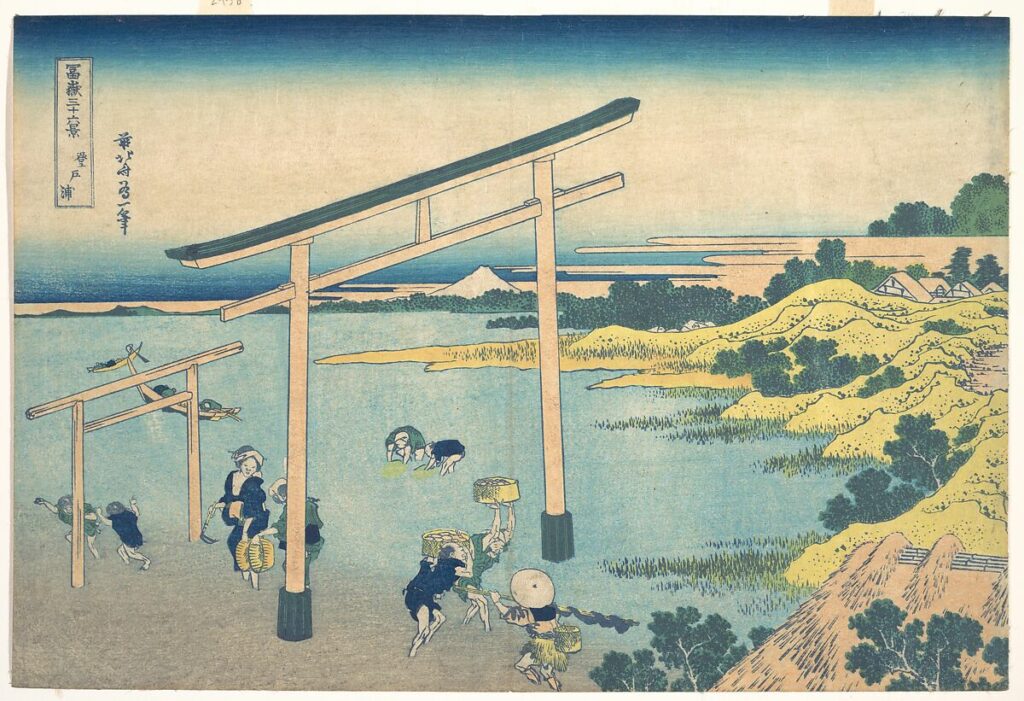
The torii gate has been a symbol of life, growth, vitality, protection, and renewal for thousands of years. In the Shinto religion, it is believed that all people are inherently good and that if someone is evil, that is because of evil spirits.
https://diluo.digital.conncoll.edu/Asianart/editors-pick/torii-gates-in-japan-and-japanese-religion/#:~:text=The%20torii%20gate%20has%20been,is%20because%20of%20evil%20spirits.
The sculpture is a response to the Zen garden at Ryōan-ji (15th century) and the woodblock print by Katsushika Hokusai (1830s). The raked gravel and island-like stones of Ryōan-ji inspired my layered paper rocks, flowing waterfall, and use of rhythm and repetition to suggest movement through a symbolic landscape. Hokusai’s towering torii gates influenced my focal point and guided my use of proportion and vertical emphasis to represent transition and renewal. Together, these works shaped my decisions to balance organic forms with structured elements, creating a paper environment rooted in the history and visual language of Japanese art.

In Process #1

In Process #2

In Process #3

In Process #4


